
Author: Anniina Runtuvuori-Salmela, 29.4.2026
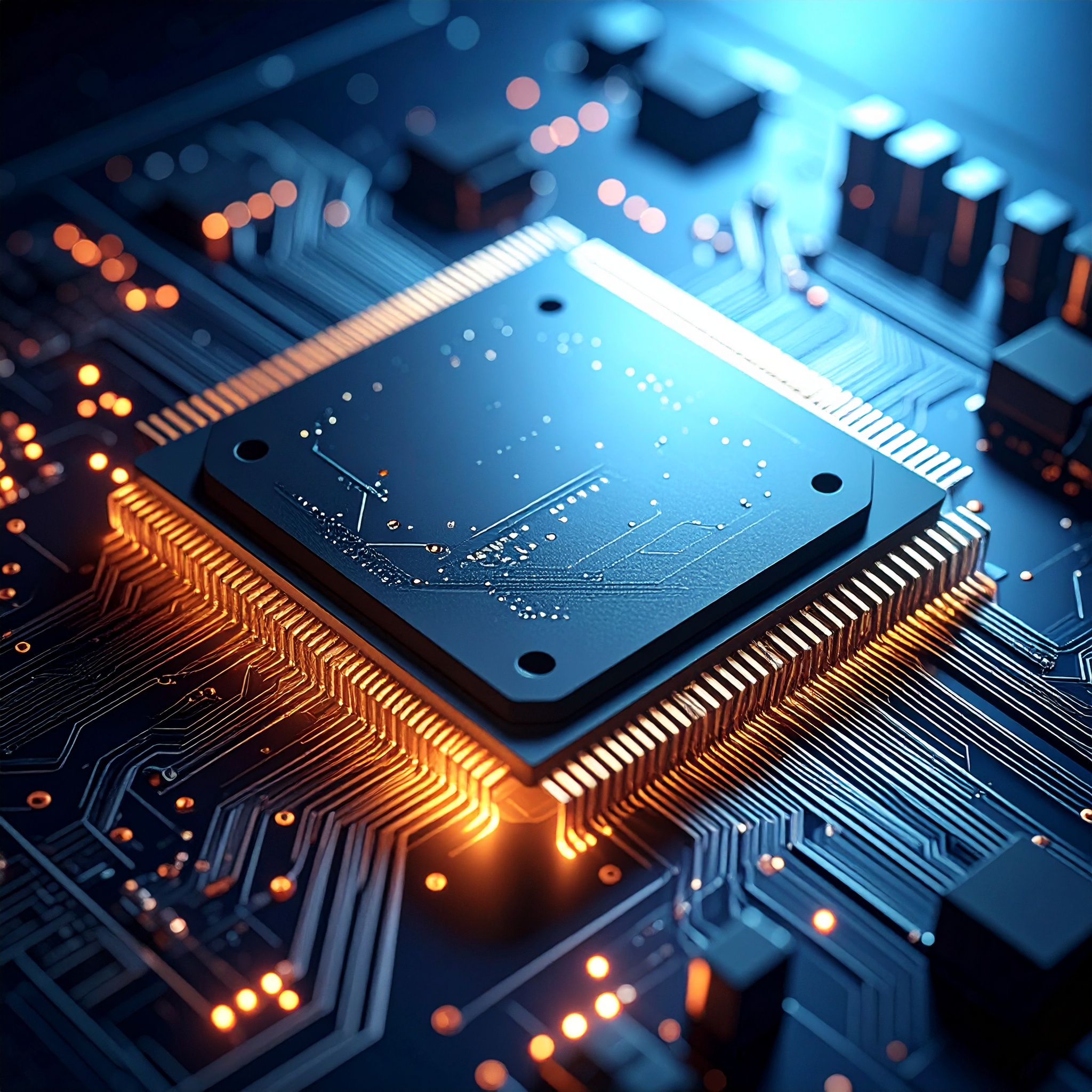
Conceptual illustration of a spin‑based silicon quantum computing chip (illustrative, not depicting a specific device). Image generated using Adobe Express.
Donor spin–based silicon quantum computing relies on the electron or nuclear spin states of individual donor atoms, most commonly phosphorus, embedded in a silicon crystal. These atoms act as qubits, where the spin states encode quantum information. The core concept was originally proposed by Bruce Kane in the late 1990s, and the approach has since attracted sustained interest due to silicon’s excellent compatibility with established semiconductor fabrication technologies (Kane, 2000).
Experimental research has demonstrated that donor spin qubits in silicon exhibit exceptionally long spin coherence and relaxation times, ranging from milliseconds to seconds and, in some cases, extending to tens of seconds, particularly in isotopically purified 28Si. High‑fidelity single‑ and two‑qubit gate operations have also been achieved, making this platform one of the most promising solid‑state implementations for quantum information processing (Morello et al., 2020; Hsueh et al., 2023).
Currently, donor spin–based silicon quantum systems are being explored as building blocks for scalable quantum processors and quantum memories, with experimental demonstrations of high‑coherence donor and donor‑molecule spin qubits in silicon nanostructures (Fricke et al., 2021). More broadly, donor spin platforms are considered promising for integration into larger‑scale quantum architectures, including potential hybrid systems, as discussed in the wider literature (Morello et al., 2020). A key advantage of donor spin–based silicon quantum computing is its compatibility with established silicon fabrication processes, which supports long‑term scalability and potential industrial integration.
References
1. Kane, B. E. (2000). Silicon-based quantum computation. Fortschritte der Physik, 48(9–11), 1023–1041. https://arxiv.org/abs/quant-ph/0003031
2. Morello, A., Pla, J. J., Bertet, P., & Jamieson, D. N. (2020). Donor spins in silicon for quantum technologies. Advanced Quantum Technologies, 3(12). https://advanced.onlinelibrary.wiley.com/doi/pdf/10.1002/qute.202000005
3. Hsueh, Y.-L., et al. (2023). Hyperfine-mediated spin relaxation in donor-atom qubits in silicon. Physical Review Research, 5, 023043. https://journals.aps.org/prresearch/abstract/10.1103/PhysRevResearch.5.023043
4. Fricke, L., et al. (2021). Coherent control of a donor-molecule electron spin qubit in silicon. Nature Communications, 12, 3543.